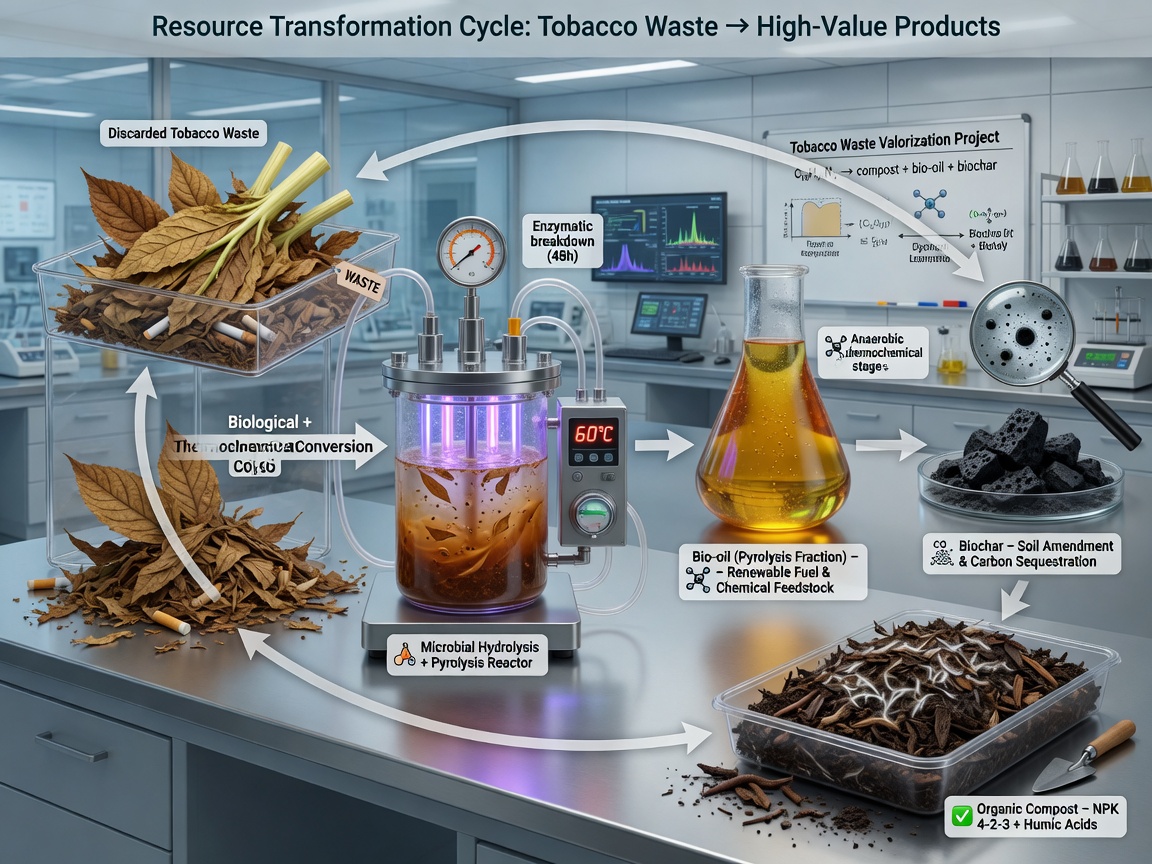
Schematic diagram of waste tobacco leaf resource treatment and organic fertilizer conversion process
Technical Treatment Parameters and Resource Utilization Pathways of Waste Tobacco Leaves and Processing By-products
The treatment of waste tobacco leaves and their processing by-products (tobacco stems, tobacco dust, tobacco powder, etc.) is not a simple "waste disposal" but a precise process involving biochemical degradation and thermochemical conversion. Tobacco waste is characterized by high nitrogen content, high nicotine content, and uneven ash distribution, which make its technical difficulty in composting and energy conversion far higher than that of ordinary crop straw.
Aerobic Composting: Parameter Game of Biodegradation and Toxicity Control
The core of converting waste tobacco leaves into organic fertilizer lies in achieving organic matter stabilization and nicotine biodegradation through aerobic fermentation. If parameters are not properly controlled, the fermentation system can easily become anaerobic, emit large amounts of ammonia, or leave residual toxicity in the product.
1.1 Carbon-Nitrogen Balance (C/N Ratio) and Dynamic Moisture Adjustment
The initial C/N ratio of tobacco waste (especially tobacco stems) is typically low, often between 15:1 and 20:1, which causes nitrogen to release too quickly in the early fermentation stage, producing large amounts of ammonia—not only causing nitrogen loss but also inhibiting microbial activity.
In practice, high-carbon amendments (such as corn stover, sawdust, or bran) must be introduced for adjustment. The optimal initial C/N ratio should be controlled at 25:1 to 30:1.
Moisture control is equally critical. Due to their large surface area, tobacco leaves easily absorb or lose moisture during drying. The moisture content of the fermentation system must be stabilized in the range of 55%–65%. If moisture falls below 50%, microbial metabolic activity is insufficient and temperature rise is slow; if moisture exceeds 70%, the material pores are filled with water, oxygen diffusion is blocked, and the system rapidly turns anaerobic, producing strong hydrogen sulfide (H₂S) and organic acid odors.
1.2 Temperature Curve "Lifeline" and Nicotine Degradation
The temperature curve of the composting process is a core indicator of fermentation quality. A standard, successful composting process should go through the following stages:
- **Heating Phase (1–5 days)**: Temperature rapidly rises from ambient to above 50°C. Microorganisms begin to proliferate extensively.
- **Thermophilic Phase (5–20 days)**: **The temperature must be stabilized between 55°C and 65°C.** This range is the critical window for killing pathogens, weed seeds, and degrading nicotine. If the temperature exceeds 75°C, thermophilic bacteria die and the fermentation process is interrupted.
- **Cooling and Maturation Phase (after 20 days)**: As organic matter degrades, microbial activity decreases, and the temperature gradually returns to ambient.
For nicotine degradation, field data show that maintaining a stable high temperature of 55°C–60°C for at least 14 days can reduce nicotine content by more than 85%. If the temperature is controlled below 40°C, nicotine degradation efficiency drops exponentially, resulting in a final product that inhibits soil microorganisms.
Thermochemical Conversion: Path Selection from Biomass to High-Value Energy
When the scale of waste tobacco leaves reaches industrial levels, or when large amounts of tobacco dust and powder need to be rapidly disposed of, thermochemical conversion pathways (pyrolysis and gasification) demonstrate higher efficiency.
2.1 Pyrolysis Pathway: Yield Game of Bio-oil and Biochar
Pyrolysis is a controlled decomposition process carried out in an oxygen-free or inert atmosphere. For tobacco waste, the product distribution is highly sensitive to reaction temperature.
- **Low-Temperature Pyrolysis (300°C–450°C)**: The main goal at this stage is to produce biochar. At around 400°C, the biochar yield can reach 40%–50%. Volatile release is slow at this stage, and the carbon pore structure is well-developed, making it suitable for use as a soil amendment or adsorption material.
- **Medium-Temperature Pyrolysis (450°C–600°C)**: This is the **peak range for bio-oil yield**. Through fast pyrolysis technology, the bio-oil yield can be increased to over 45% at around 500°C. Due to the high nitrogen content in tobacco, the bio-oil produced at this stage has a high nitrogen content, presenting a complex mixture of phenols, ketones, and pyridine compounds.
- **High-Temperature Pyrolysis (>650°C)**: Secondary cracking reactions are intense at this stage, causing a sharp decline in bio-oil yield and instead producing large amounts of non-condensable gas (syngas).
Core Technical Parameter Table:
| Parameter | Target: High Bio-oil Yield | Target: High Biochar Yield | Target: High Syngas Yield |
|---|---|---|---|
| **Reaction Temperature** | 450°C – 550°C | 350°C – 450°C | 800°C – 950°C |
| **Residence Time** | Very short (seconds to minutes) | Longer (30–60 min) | Moderate |
| **Heating Rate** | Fast heating | Slow heating | High speed |
| **Product Characteristics** | Nitrogen-containing organic liquid fuel | High-carbon, porous solid | Mainly CO, H₂, CH₄ |
2.2 Gasification Pathway: Precision Control of High-Efficiency Syngas
Gasification is the process of reacting biomass at high temperature with a controlled amount of oxidant (air, oxygen, or steam) to produce syngas. For tobacco waste, the equivalence ratio (ER) is the core parameter controlling product calorific value.
Typically, the equivalence ratio should be controlled at 0.2–0.3. If the ER is too high, the reaction tends toward complete combustion, producing CO₂ and water; if the ER is too low, the reaction is insufficient, generating large amounts of tar that block downstream equipment. Under high-temperature gasification conditions around 850°C, the syngas calorific value can stabilize at 12–15 MJ/m³, offering good industrial utilization value.
Practical Case: Technical Review of a Large Tobacco Processing Plant By-product Disposal Project
In 2022, I served as on-site technical supervisor for a waste resource project at a provincial tobacco enterprise. The plant produced approximately 50 tons of mixed tobacco stems and dust daily, with the treatment goal of converting it into high-quality organic fertilizer.
Tricky Problem Encountered:
On the 12th day of project operation, the monitoring system alarmed that the center temperature of the fermentation pile had abnormally soared to 78°C, then rapidly dropped to 35°C within 48 hours, accompanied by a pungent sour odor from the pile.
Root Cause Analysis:
Through on-site sampling and material analysis, the root cause was identified as dynamic imbalance in material ratio. Due to continuous rainfall in the previous week, the moisture content of the tobacco stems stored on site surged from the preset 60% to over 75%. The high moisture content reduced the internal porosity of the pile, preventing oxygen penetration and shifting the fermentation system from aerobic to anaerobic; simultaneously, the excessive moisture caused heat to accumulate in the pile center without evaporative cooling, leading to localized high temperatures that killed most aerobic microorganisms.
Solutions and Improvements:
- **Emergency Intervention**: Immediately stopped water addition, forced ventilation through mechanical turning, and mixed in large amounts of dry corn stover to reduce moisture content and increase porosity.
- **Microbial Reinvigoration**: After moisture dropped to 60%, heat-resistant cellulose-degrading bacteria and nitrifying bacteria were specifically inoculated to force a secondary fermentation.
- **Parameter Standardization**: Established a linked control logic based on "moisture content - aeration rate - temperature." It was stipulated that when the pile temperature exceeded 68°C, forced ventilation would automatically increase; when moisture content exceeded 65%, dry material must be added at a ratio of 1:3 (wet material:dry straw).
Through these improvements, the composting cycle of the project was shortened from an unstable 50 days to 35 days. The final organic fertilizer product achieved a germination index (GI) stable above 85%, with residual nicotine below 0.05%, successfully passing agricultural department inspection.
Technical Summary and Industry Observations
From a technical pathway perspective, the treatment of waste tobacco leaves is transitioning from "end-of-pipe disposal" to "precision resource utilization."
The bottleneck of composting technology lies not in microbial strains but in real-time dynamic control of complex physical parameters (especially moisture content and porosity). For large-scale operations, establishing an automatic turning and moisture supplementation system based on sensor feedback is the only viable solution.
In the energy conversion field, the current industry pain point is corrosion and slagging of thermochemical reactors caused by the high ash content of tobacco. Alkali metal components such as potassium and calcium in tobacco readily form low-melting-point eutectics at high temperatures, leading to scaling on the inner walls of gasifiers. Future technology iteration should focus on pretreatment technologies (such as low-temperature roasting) to improve the physicochemical characteristics of the feedstock by removing some volatile components before pyrolysis, thereby enhancing the overall stability and thermal efficiency of energy conversion.