# Practical Cases of Sustainable Tobacco Cultivation — Organic Farming, Crop Rotation, Cover Crops, and Reduced Chemical Inputs
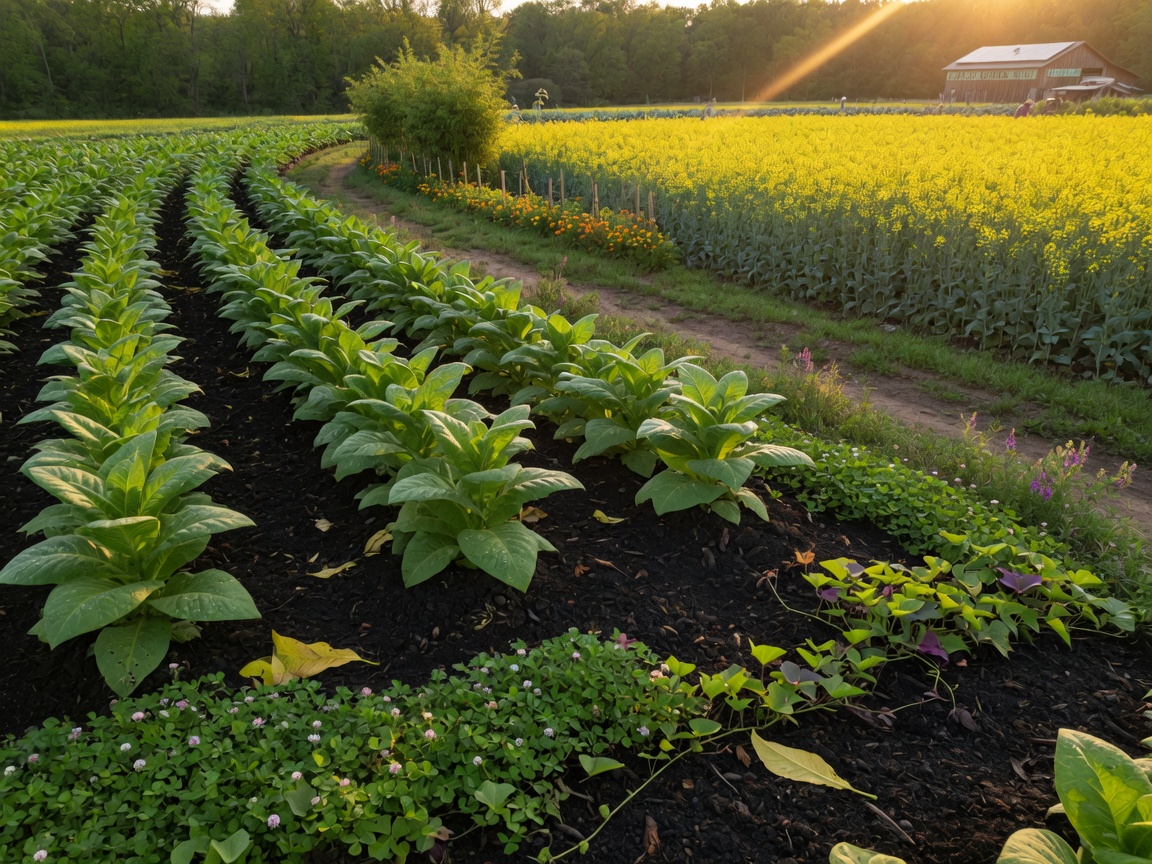
In late October 2022, the tobacco leaves in a dam area of Yuxi, Yunnan, had basically finished curing. I followed a local technician to a demonstration field of about **12 mu**: the ridges had been mostly leveled, and **Guangye Zihua Shao** (a local vetch variety) seeds had been sown a week earlier at about **2.5–3 kg per mu**, then lightly mixed with a disc harrow. The adjacent control field followed the old habit: tobacco stalks cleared, bare soil overwintering, waiting for a "one-shot" compound fertilizer application the following February. The technician kicked a clod and said: "Come back in March next year — the ground with green manure will be soft under a hoe; the one without will crust after a rain."
What I noted that time wasn't a slogan but a very down-to-earth comparison table: **the same village, same variety, same curing master — three years after starting 'tobacco–green manure–reduced nitrogen', chemical nitrogen was about 20% less than the village average, bacterial wilt incidence dropped from about 8% to around 3%, fresh leaf yield per mu decreased slightly while the average price increased slightly.** Sustainable tobacco cultivation is not about turning tobacco fields into parks, but using **organic materials, crop rotation, and cover crops** to pull chemical inputs back from "habitual stacking of fertilizer and pesticides" to a "calculable and measurable" range. Below I write based on what I have seen, asked about, and cross-checked against published trial scales — what can be replicated and what are merely highlights, explained together.
I. Let's Be Clear First
1. **Agronomic sustainability ≠ smoking becoming safe.** Higher soil organic matter and lower pesticide residues improve the growing environment and raw material boundaries; the health risks of combustion inhalation are not thereby canceled.
2. **"Organic tobacco" and "reduced chemical inputs" are not the same path.** The former is constrained by certification, organic fertilizer sources, and pest outbreak years, so areas tend to be small and expensive; the latter is more realistic in conventional contracted tobacco, targeting a **15–30% reduction in nitrogen and pesticides while maintaining grade structure**.
3. **Research station data looks good; in the field, labor costs and purchase prices will slap you.** Plowing under green manure requires an extra hired labor day, legume seed prices rise, and rotation years mean "no tobacco to deliver" — all of which push farmers back to continuous cropping. Discussing effects must include institutional context.
4. **My judgment:** In the southwestern tobacco regions, **the most worthwhile first step is not full organic, but 'rotation to break continuous cropping + winter/spring cover/green manure + organic substitution for part of chemical nitrogen + lime/organic matter to counter acidification'**. Stack these four together, and chemical reduction stands a chance; cutting one bag of urea alone usually means it comes back the next year.
II. Organic and Near-Organic: It Can Be Grown, But Don't Mythologize the Yield Curve
1. What Domestic Exploration Looks Like
Since the late 2000s, Yunnan and other regions have conducted organic tobacco trials and demonstrations: floating seedling systems replaced with organic substrates and permitted biological agents, the field relying mainly on **decomposed farmyard manure, commercial organic fertilizer, and cake fertilizer**, pest control through rotation, trapping, biological pesticides, and manual removal. The common thread in published reviews and local demonstration materials is: **the system can work, but it is extremely sensitive to soil baseline and pest pressure** — land with severe continuous-cropping obstacles and high soil-borne disease loads will be left exposed in the first year of organic management.
Organic practice materials from Indian and other producing regions often list **legume rotation, green manure, and biological control** as standard; small-scale organic/natural growers in North America emphasize **cover crops (clover, rye) + mechanical cultivation**. The logic is consistent: **without herbicides and quick-release nitrogen, you rely on time, biomass, and labor.**
2. A Reproducible Operational Flow (Near-Organic Demonstration Field, 2019–2021, Compiled from Interviews Around Southern Guizhou)
| Period | Operation | Dosage/Key Points | Pitfalls Encountered |
|---|---|---|---|
| Oct–Nov of prior year | Sow green manure after tobacco (vetch or rapeseed) | Vetch about 2–3 kg/mu | Sown too late, insufficient biomass |
| Late Feb–early Mar of following year | Plow under green manure | Plow around early flowering, sun-dry 7–10 days before ridging | Transplanting immediately after plowing → root burn, slow recovery |
| Before ridging | Base apply decomposed cow manure/commercial organic fertilizer | About 800–1500 kg/mu (depending on source) | Not fully decomposed → underground pests and seedling burn |
| 15–25 days after transplanting | Biological fertilizer/organic top dressing | Small amounts, multiple times | Nitrogen deficiency before vigorous growth → small leaves, weak structure |
| Full growing period | Yellow sticky traps, sex pheromones, manual caterpillar removal | 1–2 field inspections per week | Outbreak years may still require permitted biological pesticides |
| After topping | Strict nitrogen control, rely on earlier organic nitrogen pool | — | Slow organic mineralization, even more "starved" in cold weather |
3. Results and My View
- **Visible positive effects:** Soil color darkens, earthworms increase, surface crusting reduces; pesticide spray frequency can be cut from 5–7 times per season to 2–4 times (in years with light pest pressure).
- **Costs that must be acknowledged:** Labor per mu increases; fresh leaf yield commonly fluctuates **5–15%**; upper leaf body sometimes lacks the "punch" of high-nitrogen conventional fields, but combustion and off-flavor issues are more stable in well-managed plots.
- **Published demonstrations of high-end custom tobacco** have reported reductions of about **22.5%** in chemical fertilizer compared to conventional levels, slight increases in soil organic matter, and improvements in emission-related indicators — but these were supported by **order premiums + technical packages**, not the ceiling replicable by individual farmers.
**Personal view:** Full organic suits "small area, high premium, controllable pest pressure" orders; for most farmers delivering conventional flue-cured tobacco, **extracting the 'green manure + decomposed organic fertilizer + reduced spraying' components** from organic techniques is more economical than obsessing over certification. Certification is a market tool, not the only correct answer in soil science.
III. Crop Rotation: The Knife Against Continuous-Cropping Obstacles, Also the Knife on Area Accounting
1. Why Tobacco Fields Particularly Fear Continuous Cropping
Tobacco belongs to the Solanaceae family, the same as tomato, eggplant, pepper, and potato. After 3–4 years of continuous cropping, the common combination punch is:
- **Soil-borne diseases:** increased pressure from bacterial wilt, black shank, and root-knot nematodes;
- **Microbial and enzymatic stoichiometric shifts,** root exudates and residues making "the land increasingly picky about fertilizer";
- **Acidification and nutrient imbalance** (high potassium removal, nitrogen-biased fertilization) stacking up, manifesting as "more fertilizer but harder to grow tobacco."
The value of rotation is not first "an extra season of grain," but **switching hosts, changing root exudation profiles, and giving the soil a respiration year without tobacco**. Research has reported positive effects for tobacco–rice, tobacco–corn/rapeseed, and tobacco–green manure patterns: more stable microbial networks, improved rhizosphere environments, and reduced disease baselines.
2. Common Operable Sequences in Southwest Tobacco Regions
| Pattern | Sequence | Effect on Soil/Disease | Effect on Farmer Cash |
|---|---|---|---|
| **Tobacco–rapeseed–tobacco** | Plant rapeseed after tobacco, sell seed or plow under | Improves structure, partly suppresses weeds | Seed can be sold, relatively easy to accept |
| **Tobacco–corn/soybean–tobacco** | Alternate years, one grain/legume season in between | Breaks Solanaceae continuous cropping | Feels like "losing area" when grain prices are low |
| **Tobacco–green manure (winter fallow)–tobacco** | Doesn't occupy main season, only winter-spring | Organic matter and nitrogen buffering | Almost no direct cash, relies on next tobacco season to compensate |
| **Tobacco–rice (dam areas)** | Paddy-upland rotation | Harsh on some soil-borne diseases and weeds | Requires water source and machinery support |
A typical example from a township in Guizhou in 2020: the village collective designated **40%** of suitable tobacco land as "alternate-year rotation zones," with the tobacco office helping arrange rapeseed procurement. In the first year, farmers complained about delivering less tobacco; in the second year, disease incidence on previously continuous-cropped heavy-disease fields dropped noticeably, and farmers finally accepted that "rotation is buying insurance." **Without procurement support or subsidies, rotation area will quickly shrink back in years when tobacco prices are good.**
3. Three Things Easily Done Wrong
1. **Choosing rotation crops that are Solanaceae relatives or nematode hosts** — the rotation is effectively wasted.
2. **Rotating but not reducing nitrogen** — soil fertility is recovering, but the fertilization habit still follows "continuous-cropping standards," wasting fertilizer and continuing acidification.
3. **Removing all tobacco stalks from the field for fuel** — rotation reduces disease pressure but continues to remove potassium and carbon; at least a portion of **tobacco stalks should be composted or charred and returned** to the field.
**Personal view:** Rotation is **the most cost-effective item** on the sustainability checklist, provided that order contracts allow "spatial and temporal arrangement of planting scale" rather than rigidly fixing the same plot's delivery volume every year. Technically mature, the bottleneck lies in industrial organization.
IV. Cover Crops and Green Manure: Those Five Winter Months Decide Whether You Can Cut Fertilizer Next Year
1. What They Actually Do
Cover crops/green manure are not about "harvesting an extra season of vegetables"; the main objectives are typically:
| Objective | More Suitable Type | Commonly Reported Magnitude in Published Research (Climate-Dependent) |
|---|---|---|
| Capture residual nitrogen, reduce leaching | Grasses: rye, wheat, oats | Fall cover can capture tens of lb/acre of nitrogen; higher on high-residue fields |
| Biological nitrogen fixation, spring nitrogen supply | Legumes: Chinese milk vetch, vetch, clover | Can partially replace chemical nitrogen after plow-down |
| High biomass, weed suppression, soil protection | Rye, rapeseed, mixtures | Residue cover suppresses weeds; reduces rainy-season erosion |
| Improve bulk density and porosity | Deep-rooted + high biomass | Bulk density can decrease, organic matter can rise by several percentage points |
In green manure resource studies from the Yuxi tobacco region, after about two years of continuous green manure, soil organic matter increased by approximately **14.8%–26.6%**, with available nitrogen, phosphorus, and potassium also rising to varying degrees. The national green manure system has explicitly featured model patterns such as **"green manure supporting green development of the flue-cured tobacco industry"** — indicating that green manure in tobacco regions is not just a concept but a path that has already entered demonstration lists.
No-till/reduced-till tobacco practices in North America repeatedly emphasize: **good cover crops or previous-crop residues are the prerequisite for reduced-till tobacco to work** — reducing erosion, conserving moisture, and sometimes stabilizing yield. Organic systems commonly use **cereal rye + legume** mixtures, rolled/crimped or plowed under to form a "biological mulch."
2. A Timetable You Can Follow (Central Yunnan, Central Guizhou Winter Fallow Fields, for Reference)
1. **After tobacco leaf harvesting (approx. late September to mid-October):** Clear fields promptly; if weed suppression and nitrogen capture are needed, sow a mix of **rye (or wheat) + Guangye Zihua Shao**; for simpler fertility building, sow vetch or rapeseed alone.
2. **After emergence:** Monitor moisture; in extreme drought, irrigate once with "survival water," otherwise biomass won't accumulate and spring efforts are wasted.
3. **Plow-down window (approx. mid-February to early March, around early flowering):** Legume C/N ratio is optimal at early flowering; too old, decomposition slows and competes with tobacco for nitrogen.
4. **Sun-dry for 7–14 days after plowing:** The most regrettable failure I've seen in the field is plowing green manure, low soil temperature, transplanting immediately — seedling stunted for half a month.
5. **After ridging and transplanting:** For the first 20 days, understand that "organic nitrogen is mineralizing," **reduce quick-release nitrogen topdressing**; otherwise you fall back into the high-nitrogen rut and the green manure effort is wasted.
3. Real Problems (More Important Than Benefit Propaganda)
- **Competition for water with tobacco:** In dry spring years, green manure consumes soil moisture; late plow-down hurts tobacco seedlings.
- **Competition for nitrogen with tobacco:** High-carbon residues (old rye) cause microbial nitrogen immobilization in early decomposition, yellowing tobacco seedlings — either plow earlier or apply **a small amount of starter nitrogen** at transplanting.
- **Seed and labor costs:** One mu of seed plus one machine pass — if the next tobacco season's grade doesn't show improvement, farmers will stop the next year.
- **Wrong cover crop species:** Some cover crops themselves can go to seed and become weeds if not managed properly.
- **Field fragmentation:** Sloping farmland makes machinery access difficult, manual plowing is labor-intensive; cover crop promotion moves half as fast in mountain tobacco areas.
**Personal view:** Cover crops are the **foundation** of chemical reduction. Without them, talking about organic substitution and pesticide reduction is like building a house on sand. My recommended priority: **winter green manure/cover first, then discuss nitrogen reduction ratios, and finally consider whether to pursue organic certification.**
V. Reducing Chemical Inputs: What's Being Reduced Is "Ineffective Doses," Not Science
1. Fertilizer: From "One-Shot Application" to "Partial Organic Substitution + Soil Testing"
Research from Chenzhou's tobacco–rice rotation areas has provided a very practical direction: **organic fertilizer replacing about 20% of chemical nitrogen** offers a relatively good balance among yield, quality, and cost. Southwestern demonstrations also commonly feature "15%–25% nitrogen reduction + organic fertilizer/green manure backup" packages. The key is not the numbers themselves, but:
- **Reducing habitual over-application**, not starving the tobacco;
- **Potassium must still be sufficient** (a hard constraint on tobacco leaf quality); randomly cutting potassium damages grade faster than cutting nitrogen;
- **Excess ammonium nitrogen** promotes delayed maturity and drives acidification, so nitrogen reduction is often paired with **nitrogen form adjustment and split application**.
A household I interviewed in Qujing in 2021: for three consecutive years, the base fertilizer was "commercial organic fertilizer 200 kg/mu + tobacco-specific fertilizer reduced by about 20%," with winter rapeseed plowed under for two years. His own comparison: early vigorous growth leaf color wasn't as "dark" as his neighbor's, but **after curing, the orange-yellow proportion was more stable, and insect control was needed once or twice less**. His words: "Before, I was afraid of not having enough; now, I'm afraid of overdoing it." — This is more accurate than any training PPT.
2. Pesticides: Rotation and Cover First Reduce the Number of "Must-Spray" Times
The sequence for chemical reduction in plant protection should be:
1. **Rotation + resistant varieties + disease-free seedlings** (suppress initial pathogen load);
2. **Cover and mechanical cultivation for weed suppression** (reduce herbicide use);
3. **Monitoring and thresholds** (spray only when thresholds are reached, not "insurance weekly spraying");
4. **Biological agents and mineral sources** as supplementary;
5. Chemical pesticides as the **last patch**.
Green manure and cover crop literature repeatedly mentions: proper cover can suppress some weeds and improve natural enemy habitat, thereby **reducing insecticide demand** — provided you haven't turned your field into a continuous-cropping paradise for a single susceptible variety.
3. A "Continuous-Cropping High-Input" vs. "Rotation + Cover + Reduced Input" Comparison (Experience-Based Synthesis, Not a Single Trial)
| Item | Continuous-Cropping High-Input Conventional Field | Rotation + Winter Green Manure + Organic Substitute 15–25% N |
|---|---|---|
| Winter-spring surface | Mostly bare, prone to rainy-season erosion | Covered, light erosion |
| Organic matter 2–3 year trend | Flat or declining | Commonly slowly rising (public green manure trials can show ~15%+ relative increase) |
| pH | More pronounced acidification trend | More stable with lime/organic matter |
| Soil-borne disease pressure | Accumulating | Decreases after interruption |
| Chemical nitrogen | Habitually high | Can be reduced by about 10–20% |
| Pesticide applications | Relatively many | Opportunity to reduce by 1–3 times |
| Labor per mu | Relatively low | Increases with green manure and rotation |
| Dependence on orders | Full planting every year | Requires area coordination |
VI. Several Practice Slices Worth Writing into Notes
Slice A: "Post-Tobacco Green Manure" in Yuxi Dam Area (2022–2023)
- **Practice:** Sow Guangye Zihua Shao within 10 days after curing; plow under at the end of February; reduce specialized fertilizer nitrogen by about **18%**.
- **Result (technician oral report + sampled fields):** Recovery after transplanting slightly slower by 3–5 days; caught up after rosette stage; bacterial wilt-affected fields reduced; per-mu output value close to village average.
- **Failure point:** Two households transplanted on the third day after plowing; the missing-plant rate was significantly higher than the rest of the village.
Slice B: "Alternate-Year Tobacco + Rapeseed" on Sloping Land in Southern Guizhou (2018–2021)
- **Practice:** Heavy-disease continuous-cropping land forced into alternate years; rapeseed guaranteed procurement.
- **Result:** When returning to tobacco in the third year, black shank was markedly lighter than on continuously cropped control slopes.
- **Failure point:** In a year with poor rapeseed prices, some secretly planted tobacco again — disease rebounded. **One day of institutional slack, one year of technical regression.**
Slice C: "Cover + Reduced-Till Tobacco" from North American Materials
- **Practice:** Winter cover crops provide residue, reduced-till transplanting, less topsoil disturbance.
- **Points to learn:** Soil protection takes priority over "the field surface must be as smooth as a mirror"; residue management is core technique, not a lazy farming method.
- **Points not to copy directly:** Southwest China's rainy sloping farmland and small machinery conditions differ; no-till should be adapted to **reduced-till + cover** for practicality.
VII. My Priority Ranking (For Those Who Really Want to Make Changes)
If you have only one year and a limited budget, I recommend investing resources in this order:
1. **Stop continuous cropping on heavy-disease land** (no amount of fertilizer can fill a disease pit).
2. **Winter fallow must have something growing** — green manure or cover, don't leave bare soil over winter.
3. **Try reducing chemical nitrogen by about 15%**, backed up by decomposed organic fertilizer/green manure; maintain potassium according to quality requirements.
4. **Switch plant protection to monitoring-driven**, delete "insurance sprays."
5. **Lime and organic matter** to deal with already acidified fields (pH chronically hovering around 5.0, test first then amend).
6. Pursue **organic certification** only if there's an order premium; without a premium, don't tie yourself down with certificates.
Organic, rotation, cover, chemical reduction — they are not four advertising slogans but gears on the same chain. Publicizing "reduce pesticides and fertilizer" without providing green manure seeds and rotation area outlets is like asking a farmer to ride a bike on a tightrope while taking away the balance bar.
VIII. Conclusion: Sustainable Tobacco Farming Is About "How Much Longer Can We Keep Growing"
I have seen fields where pH dropped below 5, earthworms disappeared, and bacterial wilt appeared without spraying; and fields where, after three consecutive years of green manure plus nitrogen reduction, the hoe no longer "clanged" when inserted. The difference rarely comes from some magical microbial inoculant, but from **whether you are willing to use one season of winter fallow and one year of rotation to exchange for the next five years of cultivability.**
For growers: first make cover and rotation a habit; chemical reduction will follow.
For the industry chain: use purchase prices and contract design to reward "alternate-year rotation fields" and "soil-tested nitrogen-reduced fields" — this is more effective than printing ten green production manuals.
For readers who only care about smoke: greener production is a good thing, but it is not a reason to extend your smoking years — that is a separate account.
There are already enough practices in sustainable tobacco cultivation: green manure and rotation in Yunnan and Guizhou, organic substitution and nitrogen reduction in tobacco-rice areas, and cover reduced-till on the international side. What's lacking is not concepts, but **five consecutive years of bookkeeping-style persistence** — recording biomass, application rates, disease incidence, and average prices. Fields that keep accounts will truly reduce chemical inputs; fields that only shout slogans will still carry fertilizer bags of the same weight next year.